The Expedition
What follows is the field journal of Robert & Mike — two explorers, one compass, and an autumn in Japan spent chasing the wild. Seven paintings, seven chapters. Turn the page to begin.
Scroll to open the journal. ↓
Field Dispatch
The Expedition Pack
Every expedition begins with a packed bag and an open question — what waits beyond the next ridge?
Robert and Mike shouldered their packs and followed the trail from summit to sea. The compass is waiting.
The trail awaits. ↓
The Dock
As recorded by R.
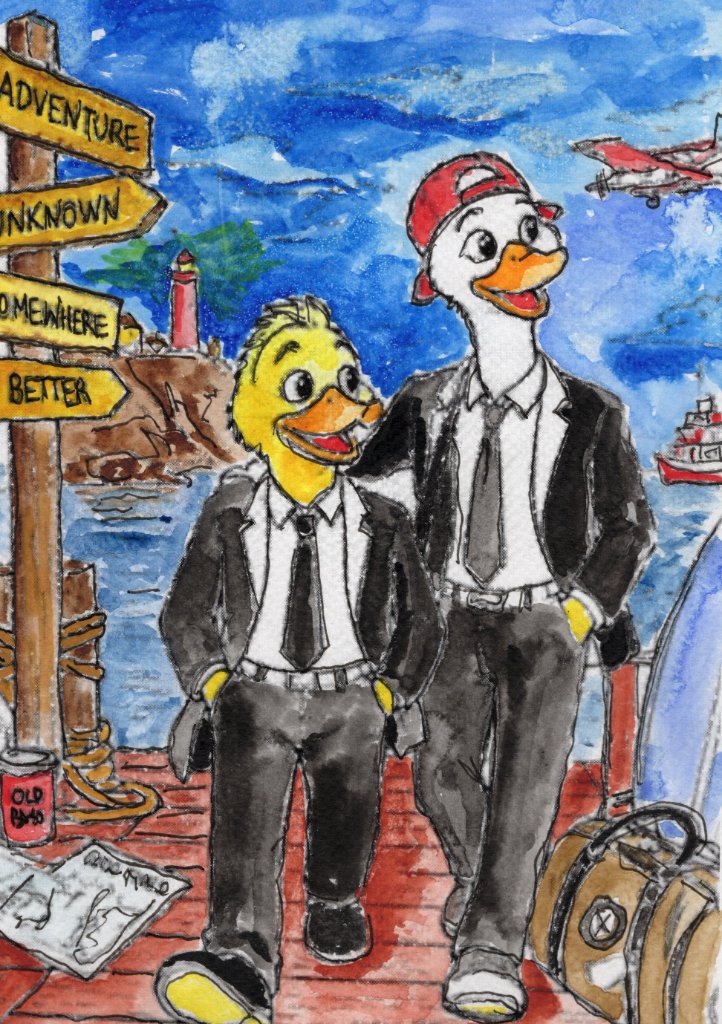
The dock stretched out over blue water, and the signpost at the end had four arms, each pointing in a different direction. Adventure. Unknown. Somewhere. Better. Robert studied them for a long time. Mike was already walking toward the ship. Between them they had one leather suitcase, one crinkled map, and a red bucket labeled OLD PASS — which Robert suspected was not an official transit document. The lighthouse stood guard on the cliff. A small red airplane circled overhead. A red ship waited at the dock. Robert picked up the suitcase and followed Mike. The signpost didn't say which direction was correct. It didn't need to. Every direction was the right one.
Four signs. Four directions. Mike picked 'Somewhere.' I picked 'Better.' We compromised on 'Unknown.' — R.
— R.
The Forest Path
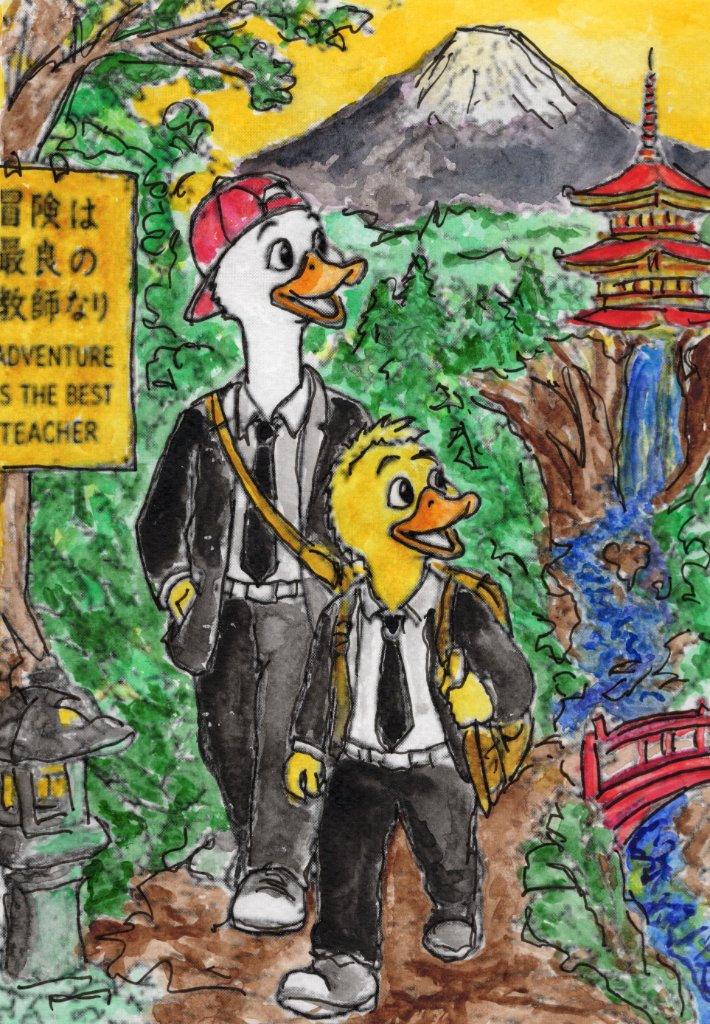
The path led them through a forest so green it hurt to look at. A red pagoda rose through the canopy, a stone bridge arched over a blue stream, and Mt. Fuji watched from the distance like a judge at the end of a long trial. The sign hanging from a branch was painted in Japanese and English. Robert read it aloud: Adventure is the best teacher. Mike, who had been complaining about his backpack for twenty minutes, went quiet. Neither of them said another word until they reached the pagoda. The forest had taught them something already — that some lessons are heard better in silence.
Adventure is the best teacher. Mike says the forest is a better teacher than him. He is not wrong about that either. — R.
— Robert
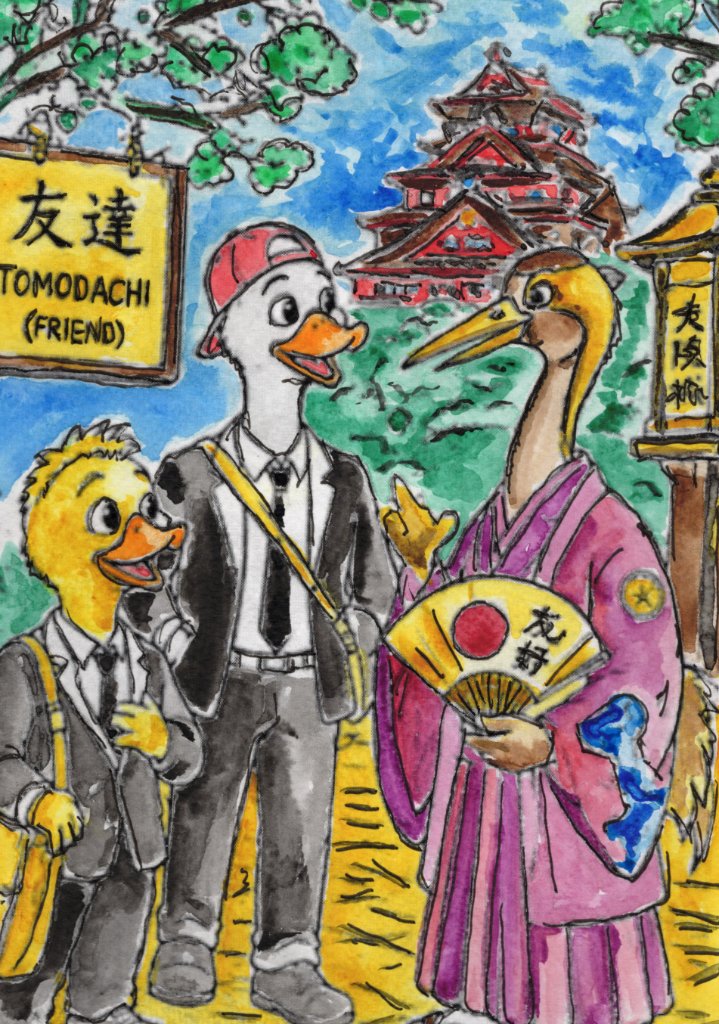
Wish you were here. We made a friend who is a crane and a castle and a kimono and a fan and a laugh. — R.
— Robert
Tomodachi
As recorded by R.
They met the crane at the castle gates. She wore a pink and purple kimono and held a folding fan painted with a red sun and characters neither duck could read. She bowed. They bowed back — too deep, then too shallow, then too deep again. She laughed. They laughed. The sign above them, hanging from a branch, read: 友達 — Tomodachi. Friend. She spoke no English. They spoke no Japanese. Within the hour they were sharing tea and stories, the universal kind told with hands and eyes and the kind of laughter that needs no translation. The pagoda stood behind them, red-roofed and ancient, and none of them were in any hurry to leave.
Made a friend today. She is a crane. She wears a kimono. She taught us how to bow (we were bad at it). The word for friend is 'tomodachi.' We learned that. She learned 'duck.' — R.
— R.
Local Flavor
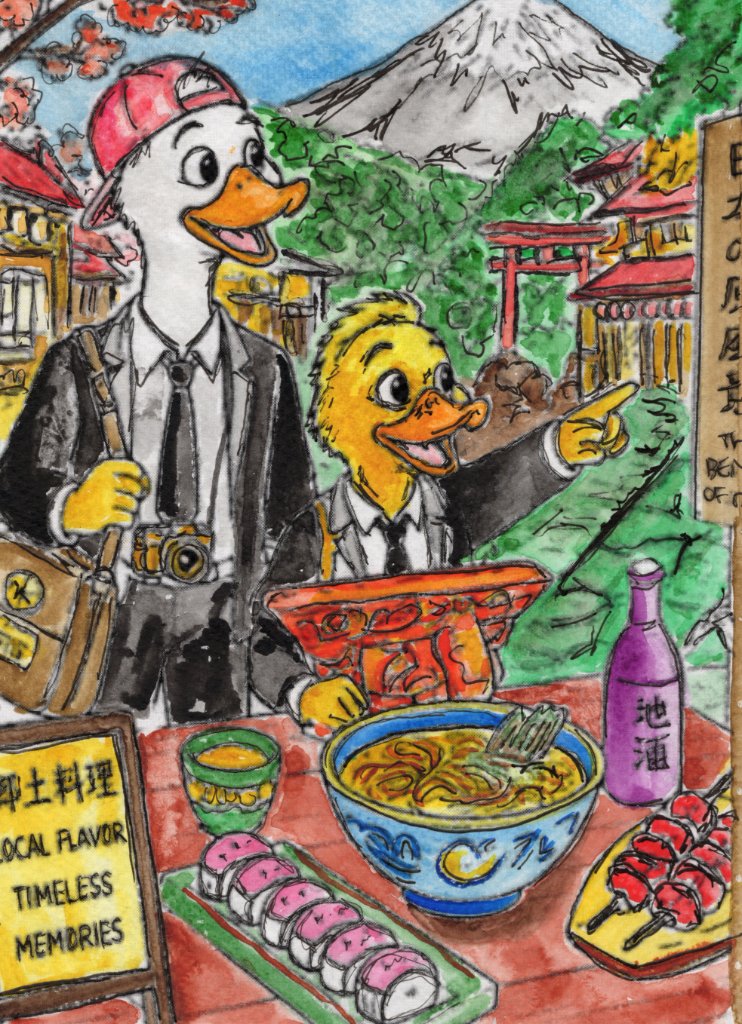
The food stall appeared at the bend in the road, and the smell reached them before the sign did. A bowl of ramen steamed on the counter — rich and enormous. A tray of pink-and-white fish cakes sat to the left. Skewers of dango waited on a plate. Mt. Fuji rose behind the stall as if the owner had requested it specifically for the view. The sign, painted in yellow and black, read: 郷土料理 — Local Flavor. Timeless. Memories. Robert pointed at everything. Mike nodded at everything. The purple bottle on the counter was never identified. Nobody cared.
Local flavor. Timeless. Memories. The sign said all three and it was right about all three. Mike ate six dango. I lost count of the ramen. — R.
— Robert
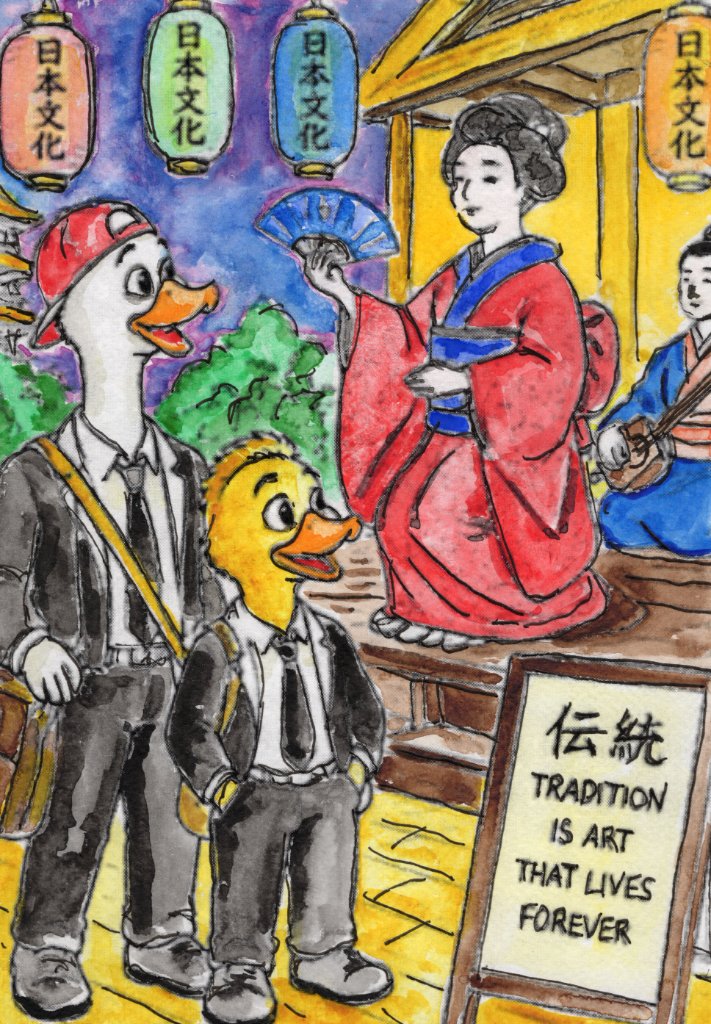
Tradition
As recorded by R.
The lanterns were lit by the time they arrived. Four paper lanterns hung overhead, each bearing the characters for Japanese Culture. On the wooden stage, a performer in a red kimono moved with a fan — slow, deliberate, ancient, each gesture a sentence in a language older than speech. To the right, a second performer in blue plucked a shamisen, its strings singing a melody that predated the castle walls. The sign at the edge of the stage read: 伝統 — Tradition is art that lives forever. Robert watched. Mike watched. Neither of them moved. The performance lasted twenty minutes. It felt like twenty seconds. It felt like a thousand years.
Tradition is art that lives forever. I wrote it down because I didn't want to forget it. Mike stood still the whole time. He will remember this. — R.
— R.
Kanpai
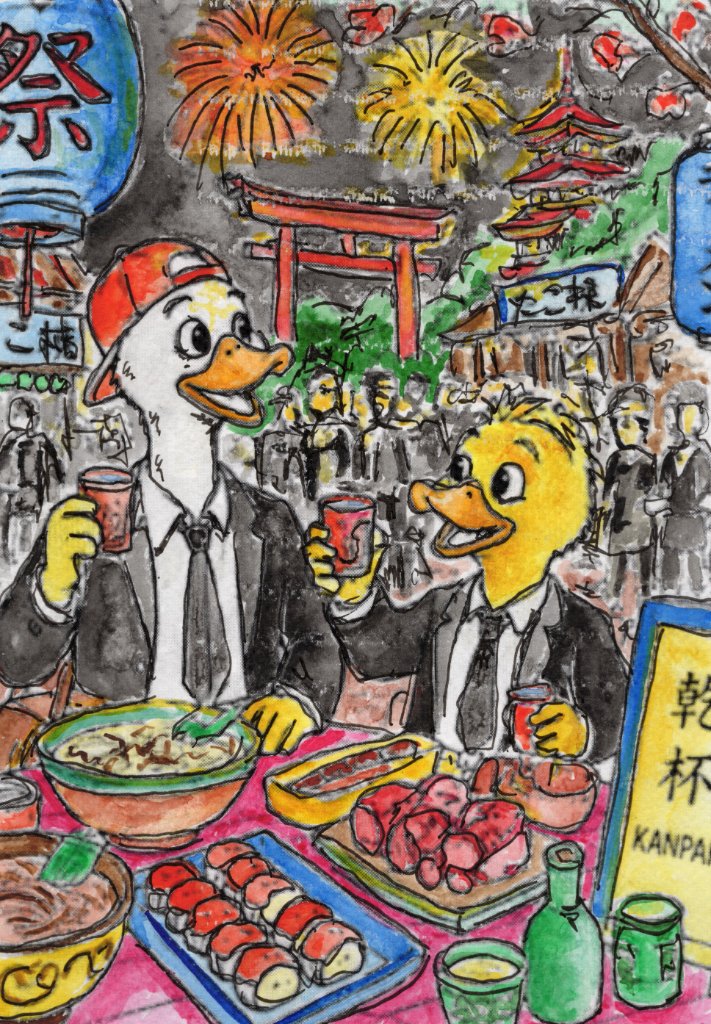
The festival erupted at dusk. Fireworks split the night sky — orange and gold against the indigo dark. The torii gate glowed red. A pagoda rose on the right like a tiered candle. They found a table with a steaming bowl of noodles, a plate of sushi, a pile of red snacks, and a green bottle that nobody questioned. A blue paper lantern hung overhead. The wooden sign beside the table read: 乾杯 — Kanpai. They raised their cups. Kanpai, said the sign. Kanpai, said the crowd. Kanpai, said Robert. Mike was already on his second cup. The crane appeared from nowhere and sat down beside them. Nobody asked how she found them. Nobody asked anything at all.
Kanpai! The crane found us again. She sat down, raised her cup, and said one word: 'Kanpai.' We understood perfectly. — R.
— Robert
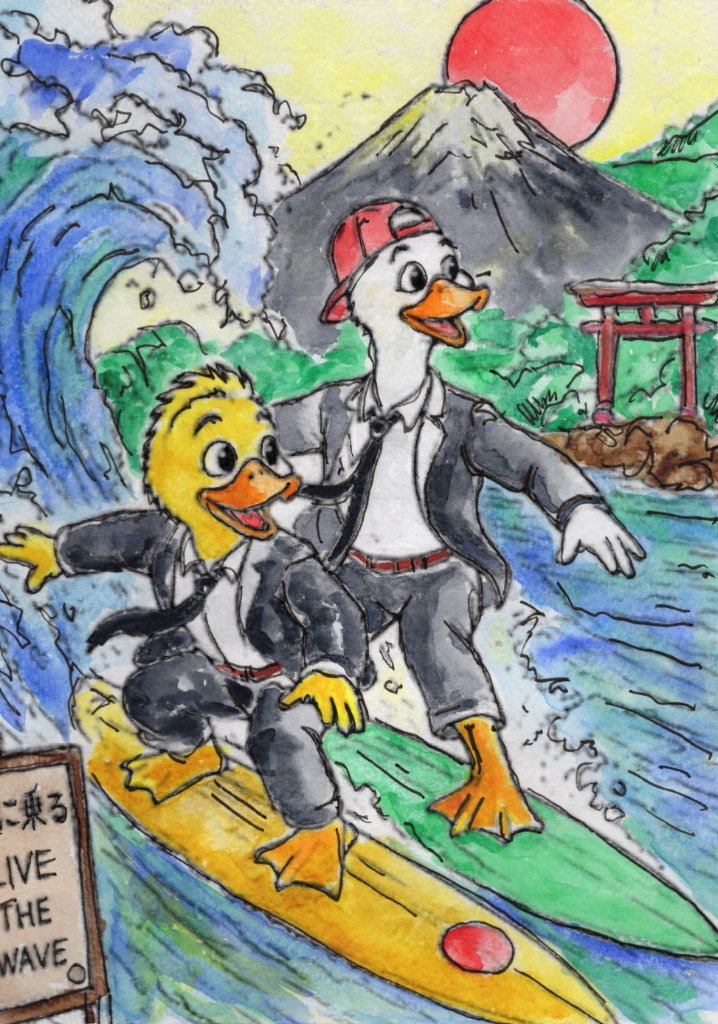
Live The Wave
The final chapter
On the last morning, they found the wave. It rose blue and green against a yellow sky, and Mt. Fuji stood behind it like a witness to everything they had seen. The surfboard was yellow with a red circle on the nose — the rising sun, painted by hand. The torii gate stood at the water's edge, red and patient, as if it had been waiting for them to arrive. Robert paddled first. Mike followed. They stood together, side by side, two ducks in suits on a yellow board, and the wave carried them toward the gate. The sign on the beach read: RIDE THE WAVE. They did. They rode it all the way to the shore.
Ride the wave. Best advice we got the whole expedition. Mike says it applies to everything. I think he's right. (Don't tell him I said that.) — R.
— R.
The Collection
Three Ways to Carry the Journey
Choose the chapter that fits your journey—from one complete destination collection to the full three-destination expedition.
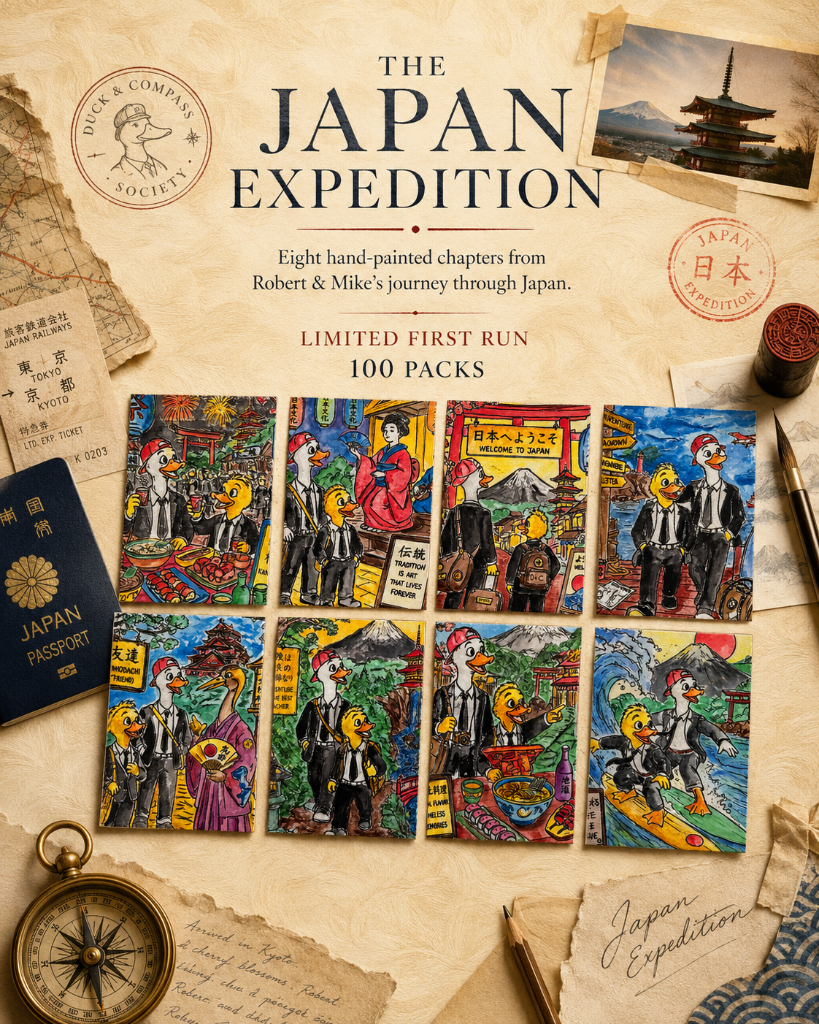
The Japan Expedition
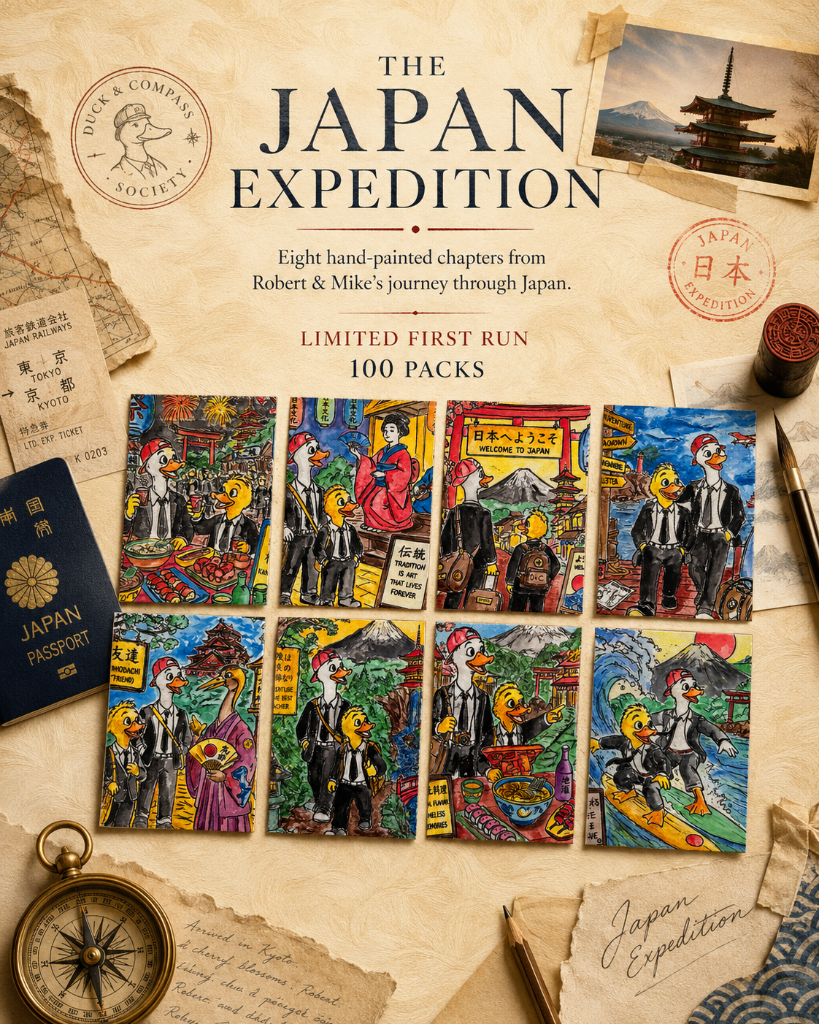
The complete Japan card collection—original watercolor chapters shaped by arrival, culture, food, friendship, tradition, and discovery.
Explore the Japan Expedition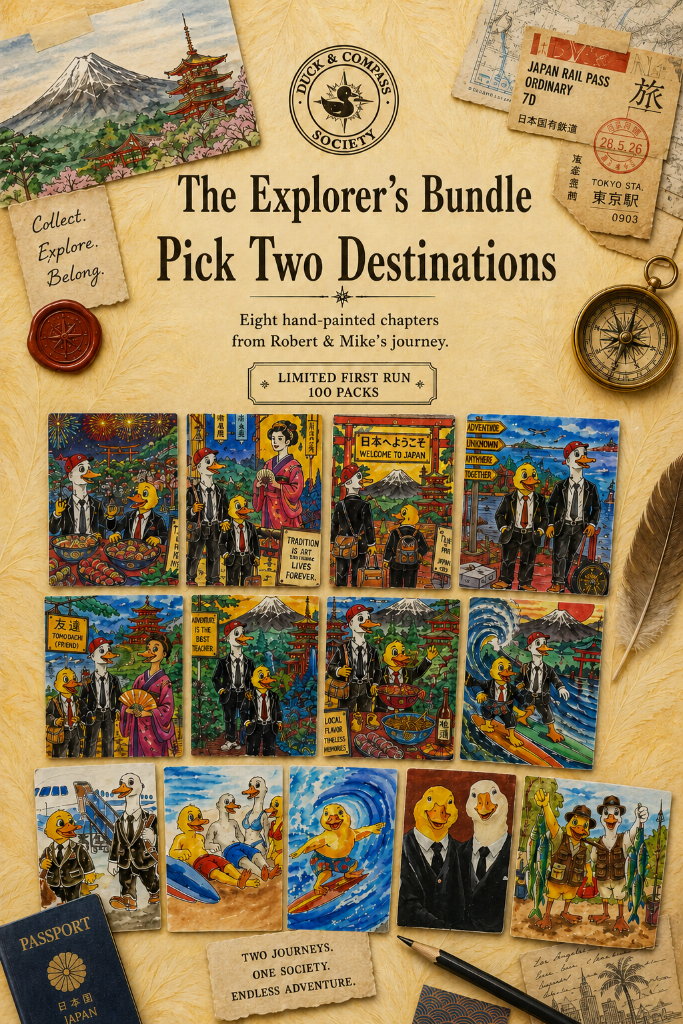
Example shown: Japan + Los Angeles. Choose any two destinations.
Build Your Explorer’s Bundle
Choose any two complete destination collections from Japan, Los Angeles, and Hawaii.
Build Your Bundle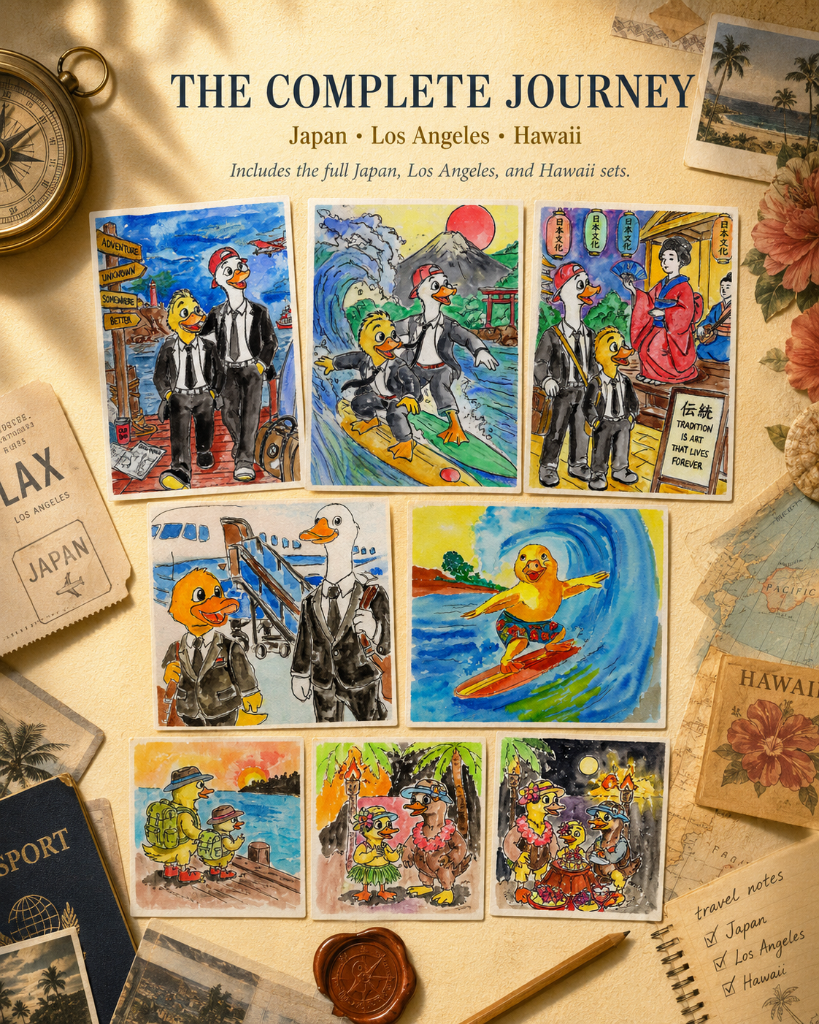
The Complete Journey
Japan, Los Angeles, and Hawaii gathered into one complete illustrated expedition.
Explore the Complete JourneyOriginal artwork. Printed in limited quantities. Packed by hand and shipped with care.